
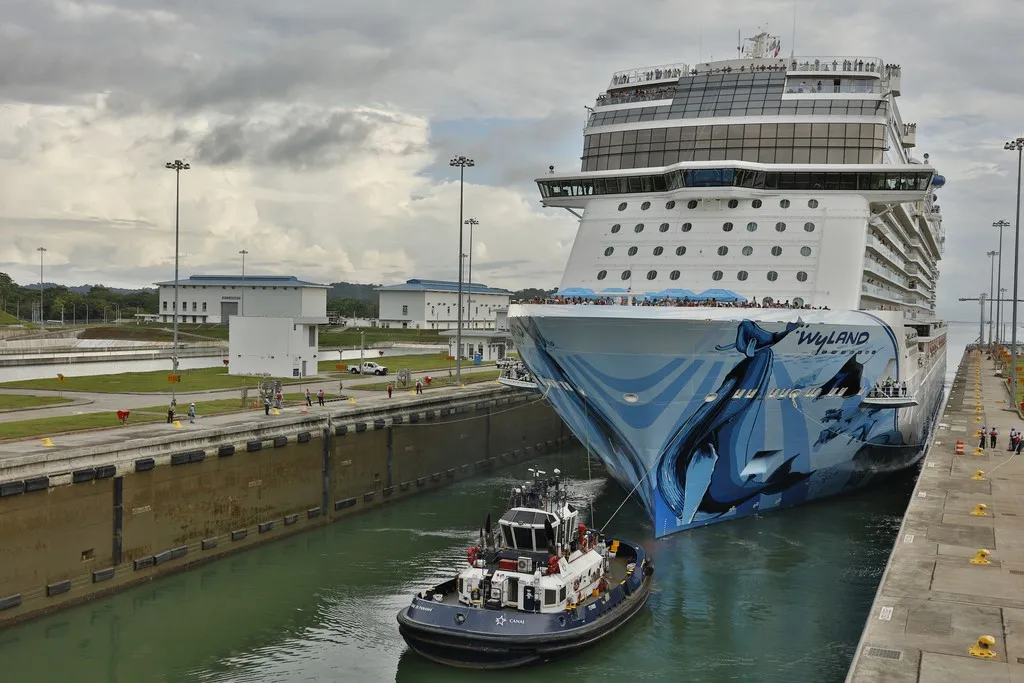
Norwegian Joy leaves Los Angeles on October 7 and arrives in Miami sixteen nights later. Norwegian Bliss does nearly the same run six days after that, on October 13, with a nineteen-night version that carries on to New York.
Those are the fall crossings — Pacific to Atlantic, ocean to ocean, all the way through. They're the least expensive way to see the Panama Canal that Norwegian Cruise Line sells, and the reason has nothing to do with a sale.
Why they're cheap
Joy and Bliss spend the summer in Alaska. They spend the winter in the Caribbean. Somebody has to move them, and the only sensible way between those two coasts is through the canal.
That sailing exists whether NCL sells every stateroom or not. The fuel gets burned, the crew gets paid, the ship arrives in Miami in late October either way. So the line prices it to fill rather than to maximize, and the result is a per-night number you won't see anywhere else in the fleet.
Balcony pricing from our snapshots dated July 26: Joy's sixteen nights run about $2,189, roughly $136 a night. Bliss's sixteen nights are about $2,259, or $141. The nineteen-night Bliss to New York is about $2,369 — $124 a night, the lowest per-night figure on any Panama sailing in our data.
That last one deserves a second look. Nineteen nights costs about $110 more than sixteen. Three additional nights, one additional port, and a different debarkation city, for less than the price of a night in an airport hotel. If the calendar allows it, it's the better buy of the two, and it isn't close.
I'd expect all of these to move between now and October. More on that below.

What the itinerary holds
This is the part people underestimate. A crossing isn't a long transit with one good day in the middle — it's a route through Central America that no other itinerary covers.
Joy's October sailing calls at Cabo San Lucas, Acapulco, Puerto Quetzal, Puntarenas, Panama City, Cartagena, and Ocho Rios. Bliss's is nearly identical, with Falmouth in place of Ocho Rios.
Puerto Quetzal is the way in to Antigua and the highland Maya sites. Puntarenas is Pacific-coast Costa Rica — cloud forest, the drier northwest. Cartagena is a walled colonial city you can spend a full day inside on foot. If a client tells me they want to see Central America from a ship, this itinerary is close to the only answer on NCL. Those ports simply aren't on the Caribbean or Mexican Riviera runs.
The rhythm is different from a transatlantic, too. A crossing pulses — a couple of sea days, a couple of port days, the canal, then a wind-down after Colombia. There's no single stretch long enough to get restless, and enough breathing room that you're not worn out by port days.
Panama City is an eastbound thing
Here's something that took reading all thirty-nine of NCL's Panama itineraries side by side to see.
Every eastbound crossing calls at Panama City. Not one westbound crossing does. All eight sailings running Pacific to Atlantic stop there. All eight running the other direction call at Colón, on the Atlantic side, and nothing else on the isthmus.
That's not a small difference. Panama City is a real city rather than a cruise port — Casco Antiguo, the colonial quarter, is a full day on its own, and it's the one stop on this itinerary that feels like visiting a country rather than a coastline. If seeing it matters to you, direction decides it, and no amount of comparing ship amenities will surface that.
One honest limit: our data shows which ports a sailing calls at, not how long it stays. Some of these calls are overnights and some are day calls, and that's worth confirming on the specific sailing before you build plans around a night ashore. I check it as a matter of course when I'm booking one of these, because an overnight in Panama City changes the trip.
The ships
Both are Breakaway Plus class, and both are large — Joy at 167,725 gross tons and about 3,776 guests, Bliss at 168,028 tons and roughly 4,010.
I haven't sailed either one. I'm hoping to get aboard both, and until I do I'm not going to tell you what the buffet is like or how the Haven feels. What I can tell you is what the class is: these are the ships NCL built for Alaska and the Caribbean, with the most onboard variety in the fleet, which matters more on a sixteen-night sailing than on a seven-night one. There's simply more to do when you have five sea days.
Size does cut the other way on canal day, when everyone is outside at once and the good rail positions go early. That's the trade against the smaller ships running the round-trip Miami sailings.
On Bliss specifically: she's had propulsion trouble through the 2026 Alaska season that's been shortening port stops, and I've written about it separately — but a repositioning is exactly the sailing where it's least likely to matter, because the schedule is built on sea days and loose pacing rather than the tight port-to-port timing that turns a couple of knots into lost hours ashore.
Getting there and home
This is a one-way trip, and the air is the part people forget to price.
You fly to Los Angeles and home from Miami, or home from New York on the nineteen-night version. That's two one-way tickets, not a round-trip, and from Kansas City or Wichita they're two separate bookings that don't help each other. Sometimes that's fine. Sometimes it adds a few hundred dollars a person over what people assumed, and it's better to know that before you're comparing the cruise fare against a round-trip Caribbean sailing.
One thing that helps: price it as a single multi-city itinerary rather than two separate one-ways. Airlines fare these differently, and on the right routing the open-jaw comes in below the sum of its halves. It doesn't always win, but it's worth checking every time, and it's the sort of thing that's easy to miss when you're booking the cruise and the air in two separate sittings weeks apart.
The upside: you get a full day in Los Angeles or a couple of nights in New York on the back end without a detour, because you're already there. On a nineteen-night sailing that ends in Manhattan in late October, I'd be strongly tempted.
What I'd watch between now and October
These sailings are inside the window where pricing tends to move. Sixty days out is where NCL often adjusts on sailings that haven't filled, and repositionings are the sailings most likely to have room, because the audience for a sixteen-night one-way is self-selecting.
That's the argument for booking early and watching: get the stateroom you want while the categories are open, then keep an eye on the fare. It doesn't always fall. On a sailing that's selling well it firms up instead, and I'd rather say that plainly than pretend the window only moves one way.
Who this is for
If you have three weeks, don't mind flying home from a different coast, and want to see Central America rather than just pass through it, the fall crossing is the best value in this category and it isn't particularly close.
If three weeks isn't available, the ten- and eleven-night round-trips from Miami give you the locks on a smaller ship with round-trip air. Different trip, and a good one.
And if October doesn't work at all, the crossing runs in the other direction in spring — and there's a winter version most people don't know exists. Both are worth their own conversation.
← Back to Choosing the Right Cruiseor continue exploring, based on how you cruise