

I am sailing Norwegian Jewel this fall, northbound from Philadelphia to Quebec City, September 26 through October 7. It is my 35th anniversary trip, and I booked it for the timing I wanted. I am confident in that timing, and I want to walk you through why, because the reasoning is the part you can actually use.
The short version: this past winter buried northern New England and Quebec under an above-normal snowpack. That water is still in the ground, and it is carrying the trees through a dry summer in exactly the places that matter most for color. On top of that, a northbound sailing is the routing most likely to cross peak color somewhere along the way. Put those together and my late-September departure is sitting in a good spot.
A Deep Dive on the Science of Peak Color
Two questions land in my inbox every fall. One is "did I pick the right week?" from people already booked. The other is "which week should I grab?" from people deciding late. Both come down to the same skill, and it is one I lean on because I chase weather as a hobby: reading what the season has already told you.
If you have already booked, this is how to judge whether your week is a good bet. If you are deciding now, at roughly 60 days out, this is how to read which sailing still makes sense. Either way, it starts with the weather, not the calendar.

Fall color starts the previous spring
Here is the biology, because it is the foundation for everything below. A tree builds a healthy canopy on spring and early-summer moisture. Come autumn, shorter days and cool nights shut down the green chlorophyll and let the reds, oranges, and golds show through. A tree that went into summer well-watered holds its leaves longer and colors vividly. A tree stressed by drought does the opposite: it mutes, browns, and drops early.
The research: Spring and early-season moisture is the single biggest lever on fall color intensity, per the US Forest Service, Michigan State Extension, and the National Forest Foundation. Drought-stressed trees produce duller color and drop leaves sooner.
The honest question in July is not "when is peak this year?" It is "how much water did these trees bank, and where?" That I can answer.

What this winter actually did
The winter of 2025 to 2026 ran heavy where it counts.
- Jay Peak, Vermont (pictured above) measured 364 inches through April 11, about 122% of normal.
- Stowe came in near 303 inches,
- Sugarloaf in Maine around 138 inches, and
- Mount Washington about 188 inches.
Across Maine, New Hampshire, and Vermont, the National Weather Service logged widespread seasonal surpluses.
The exception is the tell. The snow piled up in the highlands and the north, not the coastal lowlands. Burlington, at low elevation, actually finished the season below normal. That split matters, and I will come back to it.
The research: New England seasonal snowfall ran well above normal in the northern and higher-elevation zones by late February 2026, with northern Vermont near 122% of normal and lower elevations lagging (Country Herald, STM Weather season review). Above-normal winter precipitation also ran through Quebec (The Weather Network).
A deep snowpack is a slow-release water bank. It melts into the soil over spring instead of running straight off, which recharges groundwater and sends the trees into summer with a reserve. That reserve is a buffer against exactly the kind of dry stretch parts of the northeast are having right now.
Two forces, pulling opposite ways
The numbers below are from last Thursday's release from the US Drought Monitor, showing conditions as of July 14th.
As of that reading, about 4% of Maine sat in moderate drought with another 12% abnormally dry, concentrated along the Maine coastline and into southeastern New Hampshire, with dryness creeping into southern Vermont. This is a snapshot from roughly 10 weeks before I sail, and it can move in either direction before then, which is exactly why I keep watching it.

Moderate drought (D1) sits on the Maine coast and into southeastern New Hampshire. The northern high country and Quebec sit outside it. Reading current as of mid-July 2026; conditions update weekly.
**The research: US Drought Monitor and USGS New England. Early-July rains eased southern New England somewhat, but groundwater and streamflow remained below average.
So you have two forces working against each other: a heavy winter water bank versus a dry summer drawdown. The reason I don't worry about my sailing is that these two forces do not land evenly. They split by geography, and they split in my favor.
The coastal lowland strip (the Portland and Bar Harbor country the 7-day round-trips lean on) got less winter snow and is carrying more of the summer drought. That is a double knock on color.
The northern and inland high country, and the Quebec end of my route, got the big snowpack and the moisture reserve that comes with it. That country is shielded. When I sail into it in early October, I am sailing into the terrain best set up to color this year, not the terrain most at risk.
Nobody can hand you an exact peak date in July, and forecasters are calling 2026 a slightly later-than-usual peak, strong but late. I can tell you which ground is conditioned to color well and which is not. The date I refine as we get closer.
Why I Moved the Booking Northbound
Here is the routing piece, and it is the part most people never think about. Fall color runs north to south. It peaks first in Quebec and northern Maine, then rolls down the coast over the following weeks into southern New England.
A northbound sailing runs against that wave. Think of two cars closing on each other on a highway: you cover the gap faster than if you were both headed the same way. Sailing south to north while the color rolls north to south, I am more likely to intersect the peak band somewhere across the 11 days. A southbound run risks traveling parallel to the wave, always a week ahead of it or a week behind.
I originally booked the southbound Jewel arriving Philadelphia on September 26. I moved to the northbound departure once the directional advantage was clear. And a late season, the one forecasters are calling for, actually helps the northbound: it pushes the northern peak later, closer to my October 7 Quebec City arrival, instead of leaving it behind in late September. If you want the calendar side of this laid out separately, I wrote about reading the season instead of the sale in Make It a Season, Not a Sale.
So which sailing, if you are deciding now
Norwegian's fall Canada & New England lineup is really two different products sharing a coastline.
- The Norwegian Breakaway 7-day Boston round-trip is the accessible loop. Fly to Boston, board a big ship that carries the sea days, hit Portland, Bar Harbor, and Halifax, fly home from Boston. Simple air, shorter trip, coastal ports.
- The Jewel one-way, Philadelphia to Quebec City (10 or 11 days) is the destination-first trip. Deeper ports like Charlottetown, Sydney on Cape Breton, and Saguenay, a smaller ship at about 2,376 guests that fits those small harbor towns where a roughly 4,000-guest Breakaway-class ship overwhelms the docks, and the directional geometry above in play.
There is also a Norwegian Escape 7-day round-trip from New York running this fall, a trip I took in 2023. It is a comfortable ship for this. The catch is timing: the last New York departure is September 19, which in a late-peak year is arguably a week or two early for the best color. If you want a New York departure, you are booking the front edge of the season.
The Tactical Decision if You're Booking Now
The New York Escape option ages off the board by mid-September.
A late season rewards October departures over mid-September ones.
The Boston round-trips running into October and the Jewel one-ways...those are where you want to be.
Peak color is peak demand, and Norwegian prices it accordingly. On the same Breakaway 7-day Boston round-trip, a Balcony stateroom runs about $1,339 for a late-August sailing and about $2,779 for the mid-October foliage peak, close to double as of July 17th pricing.
My Jewel Balcony ran about $3,649 per person for the 11 nights on that same snapshot, close to $332 a night, and the 10-day southbound was actually higher per night at about $393. The one-way buys you Quebec, deeper ports, and the directional edge. It does not buy you a deal. I would rather you hear that from me now.
And if you only have a week and want a genuinely small-ship feel, I will point you at Holland America over the Breakaway loop for that specific case. I have some friends on that exact sailing, leaving the first week of October.

What the brochure photo leaves out
The marketing image is crimson maples mirrored in a harbor. The reality is that you are usually too far offshore to see meaningful color from the deck. The real value of doing foliage by ship is not the view. It is the logistics. On land at peak, you are fighting bumper-to-bumper traffic on Route 1, booked-solid inns, and a two-hour wait at every overlook. The ship is your hotel, your transport, and your logistics coordinator. You wake up in a new port and walk off into the color without any of that. Even the shore excursions, which I normally steer people away from, make sense here, because a bus into the interior is how you actually get off the coast and into the trees.
I unpacked that logistics case in The Fall Leaf Peeping Secret Most People Miss. For what a day in these ports actually looks like, the small-group Halifax tour and the rest, I keep those port write-ups on my other site: my 2023 Canada and New England trip on We Cruise NCL.
One Caveat
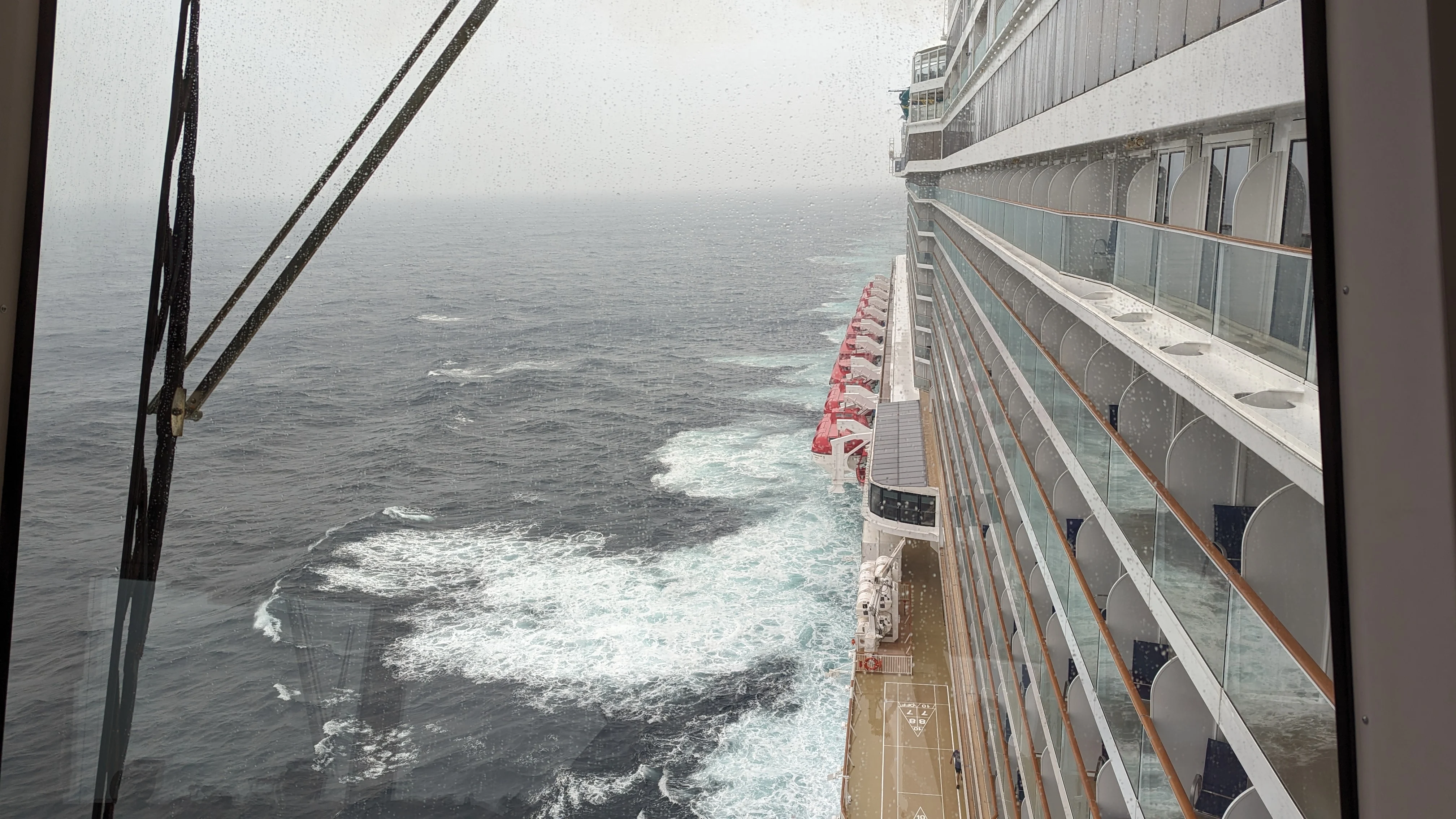
Late September into mid-October is still Atlantic hurricane season. My 2023 sailing ended with two days outrunning a storm (pictured above, from the bridge on the behind-the-schenes tour), and itinerary changes from tropical systems do happen. And I have been on the wrong side of this timing myself: my only prior Canada trip, a Norwegian Escape run the week of October 5, 2023, was too early for peak. It is the reason I now do this read before I book, instead of hoping.

The train, and getting there from the middle of the country
My wife and I are taking the train both directions, Philadelphia to the ship and Quebec City home. That is not the move for most people, since it adds a couple of travel days to an already long trip. But the one-way format is what makes it possible, because you are not doubling back to a home port, and for a milestone trip the getting-there becomes part of it. I am documenting this one as it comes together on my 2026 Canada and New England trip page at We Cruise NCL, and I will report back on how the color actually read.
For most Kansas travelers the air math is simpler than it looks: one connection to Philadelphia or Boston through Dallas, Charlotte, Chicago, or Minneapolis, and for Quebec City a flight into Montreal with a 90-minute train up. Debark at 8 am, train down, afternoon flight home is a clean same-day connection.
Where this leaves you
This is what handing the season to someone who watches it looks like. The winter told us where the water went. The map tells us which way to sail into it. The calendar tells us the window is open and the clock is running on the earlier options.
If you are already booked, send me your sailing and I will tell you honestly how your week is shaping up. If you are still deciding, we have a live 60-day window and a short list of sailings that fit both the color and the way you want to travel. Let's pick yours.
← Back to Choosing the Right Cruiseor continue exploring, based on how you cruise